Research / 研究

Research Themes研究テーマ
My research investigates fundamental physical processes in astrophysical and magnetospheric plasmas through first-principles numerical simulations on flagship supercomputers.
Cosmic-ray acceleration by large-scale PIC simulations
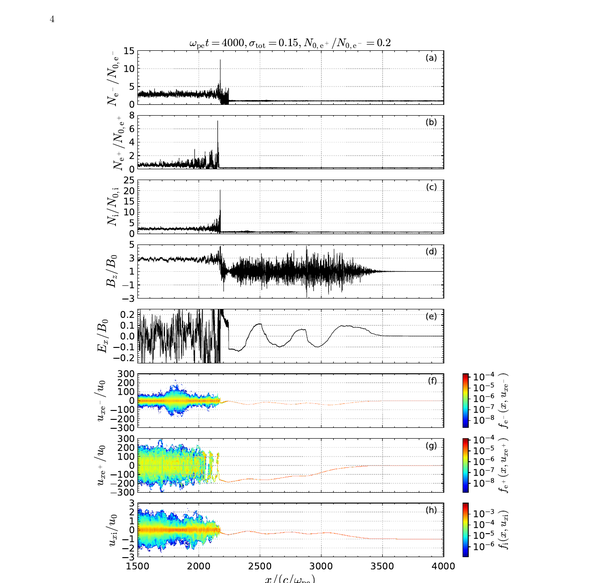
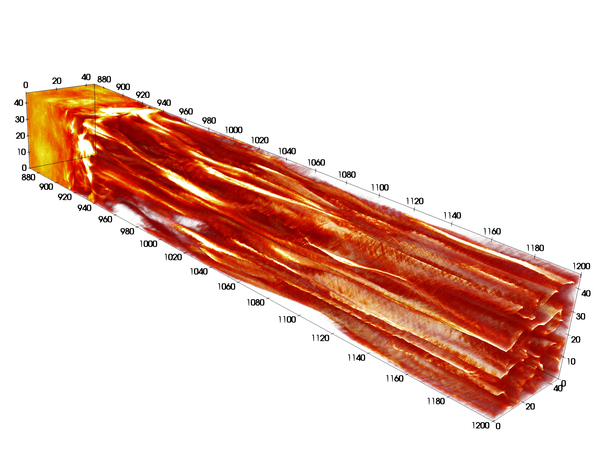
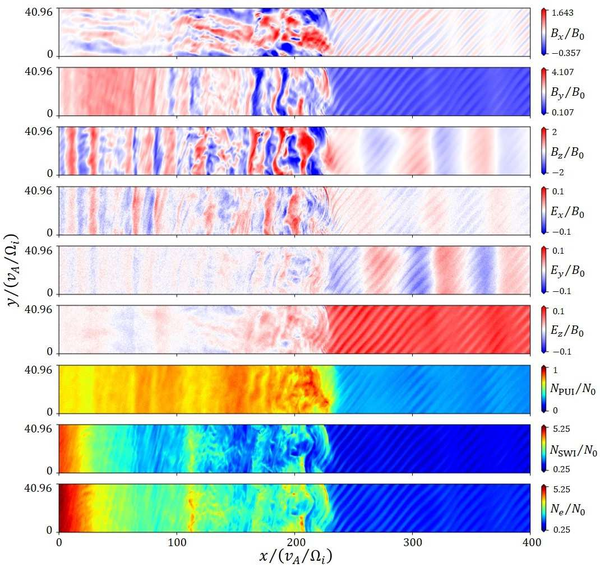
Using the electromagnetic Particle-in-Cell code WumingPIC with MPI/OpenMP hybrid parallelization on Fugaku and other supercomputers, I pursue first-principles simulations of collisionless and relativistic shocks at unprecedented scale and resolution. These calculations reveal the microphysics of cosmic-ray injection and diffusive shock acceleration at supernova remnant shocks, Weibel-instability-driven magnetic field amplification, and coherent electromagnetic emission — including linearly polarized radio waves from relativistic magnetized shocks directly relevant to the origin of fast radio bursts (FRBs). Recent results include the first PIC demonstration of selective positron acceleration via a relativistic E×B (wakefield) mechanism at pulsar-wind shocks, and elucidation of the pickup-ion injection process at the heliospheric termination shock.
Numerical modeling and visualization of Earth’s magnetosphere — the GEO-X mission
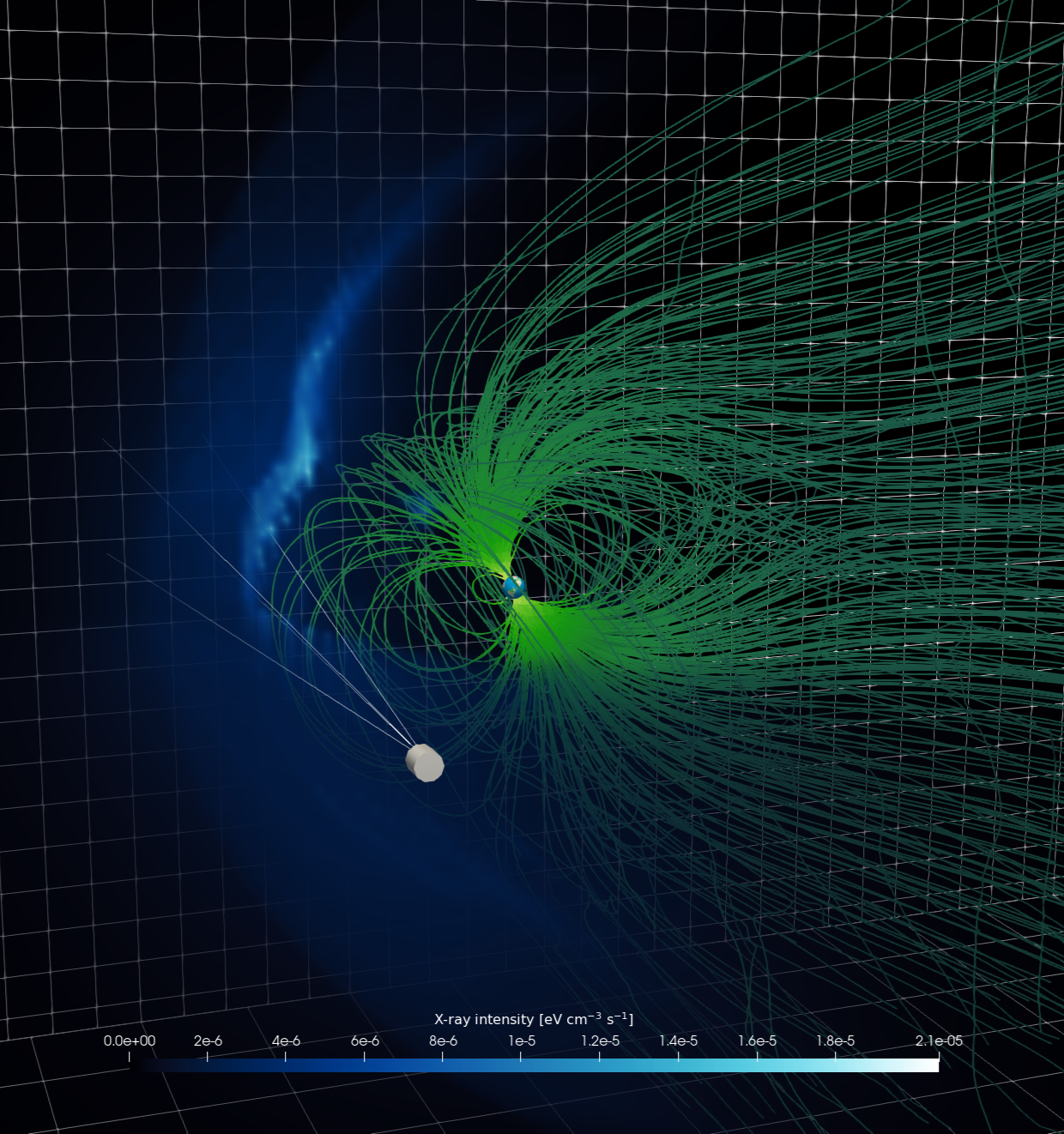
Solar wind ions charge-exchanging with geocoronal neutrals emit soft X-rays, making the Earth’s magnetosphere visible from space — the scientific basis of the GEO-X (GEOspace X-ray Imager) satellite mission. Using global MHD simulations of the terrestrial magnetosphere coupled with synthetic soft X-ray emission models, I produce forward-modeled X-ray images of the magnetopause, cusps, and bow shock. Key findings include the identification of soft X-ray brightness enhancements tracing dayside reconnection outflows under low-β solar wind conditions, and a new method to estimate the global reconnection rate from the opening angle of the X-ray bright region — directly informing the observation strategy for GEO-X.
Vlasov–Schrödinger correspondence and kinetic simulations of self-gravitating systems
Kinetic descriptions of collisionless self-gravitating systems — dark matter halos, stellar clusters — are governed by the Vlasov–Poisson equations, which are notoriously expensive to solve at high phase-space resolution. A mathematically equivalent reformulation via the time-dependent Schrödinger–Poisson equations offers an efficient route to high-resolution simulations by exploiting wave-mechanics algorithms. I am developing a time-dependent Schrödinger equation solver coupled with a Poisson solver, and investigating the formal correspondence between the Vlasov and Schrödinger descriptions in the context of astrophysical plasmas and self-gravitating systems.
Supercomputer projects, HPC code development, and GPU applications
I am an active participant in Japan’s national supercomputer projects, including the K computer and Fugaku, using their large-scale allocations to advance astrophysical plasma simulations at the forefront of HPC. The electromagnetic PIC code WumingPIC and the MHD code CANS+ are developed and optimized for these systems using MPI/OpenMP hybrid parallelization in Fortran. Looking ahead to Fugaku NEXT and other next-generation supercomputer systems, I am developing GPU-enabled applications with CUDA, HIP, or OpenACC, targeting exascale performance for future astrophysical simulations.
天体プラズマおよび天体磁気圏プラズマの基礎物理過程を、スーパーコンピュータ上での第一原理数値シミュレーションによって研究しています。
大規模PICシミュレーションによる宇宙線加速
MPI/OpenMPハイブリッド並列化した電磁粒子コード WumingPIC を富岳などのスーパーコンピュータ上で運用し、無衝突衝撃波・相対論的衝撃波の空前の規模・分解能での第一原理シミュレーションを実施しています。 超新星残骸衝撃波における宇宙線注入と衝撃波統計加速(DSA) の素過程、Weibel不安定性による磁場増幅、相対論的衝撃波からのコヒーレント電磁波放射(高速電波バーストの起源に直結)を解明しています。 最近の成果として、パルサー風衝撃波での相対論的E×B(航跡場)機構による選択的陽電子加速の初実証、および太陽圏末端衝撃波でのピックアップイオン注入過程の解明が挙げられます。
地球磁気圏の数値モデリング・可視化とGEO-Xミッション
太陽風イオンがジオコロナ中性粒子と電荷交換して放射する軟X線(SWCX)により、地球磁気圏を宇宙から可視化できます — これが小型衛星ミッション GEO-X(GEOspace X-ray Imager)の科学的基盤です。 地球磁気圏のグローバルMHDシミュレーションと合成X線放射モデルを組み合わせ、磁気圏境界面・カスプ・バウショックの合成X線像を作成しています。 低β太陽風条件下で昼側再結合アウトフローをトレースするX線増光を同定し、またX線輝度領域の開き角から全体的な再結合レートを推定する新手法を開発しました — これらはGEO-Xの観測戦略に直接貢献しています。
Vlasov方程式とSchrödinger方程式の対応と自己重力系の運動論的シミュレーション
暗黒物質ハローや星団など、自己重力を持つ無衝突系の運動論的記述はVlasov–Poisson方程式系に支配されますが、高い位相空間分解能での数値解法は計算コスト上極めて困難です。 時間依存 Schrödinger–Poisson 方程式系への数学的に等価な再定式化は、波動力学的アルゴリズムを活用した効率的な高精度シミュレーション手法として注目されています。 本研究では、時間依存Schrödinger方程式とPoisson方程式を連立した数値解法を開発するとともに、天体プラズマおよび自己重力系の文脈でVlasovとSchrödinger記述の対応関係を理論的に探究しています。
「京」「富岳」等HPC参画・コード開発・GPU応用
「京」・「富岳」をはじめとする国家基幹スーパーコンピュータプロジェクトに参画し、大規模計算資源を活用した天体プラズマシミュレーション研究をHPC分野において推進しています。 電磁PICコード WumingPIC およびMHDコード CANS+ をFortranによるMPI/OpenMPハイブリッド並列化で開発・最適化し、各世代のスーパーコンピュータに対応させてきました。 富岳NEXTをはじめとする次世代スーパーコンピュータシステムを見据え、CUDA・HIP・OpenACCを用いたGPU対応アプリケーションの開発を進め、エクサスケール時代の天体シミュレーション研究に備えています。
Highlighted Research最近の研究成果